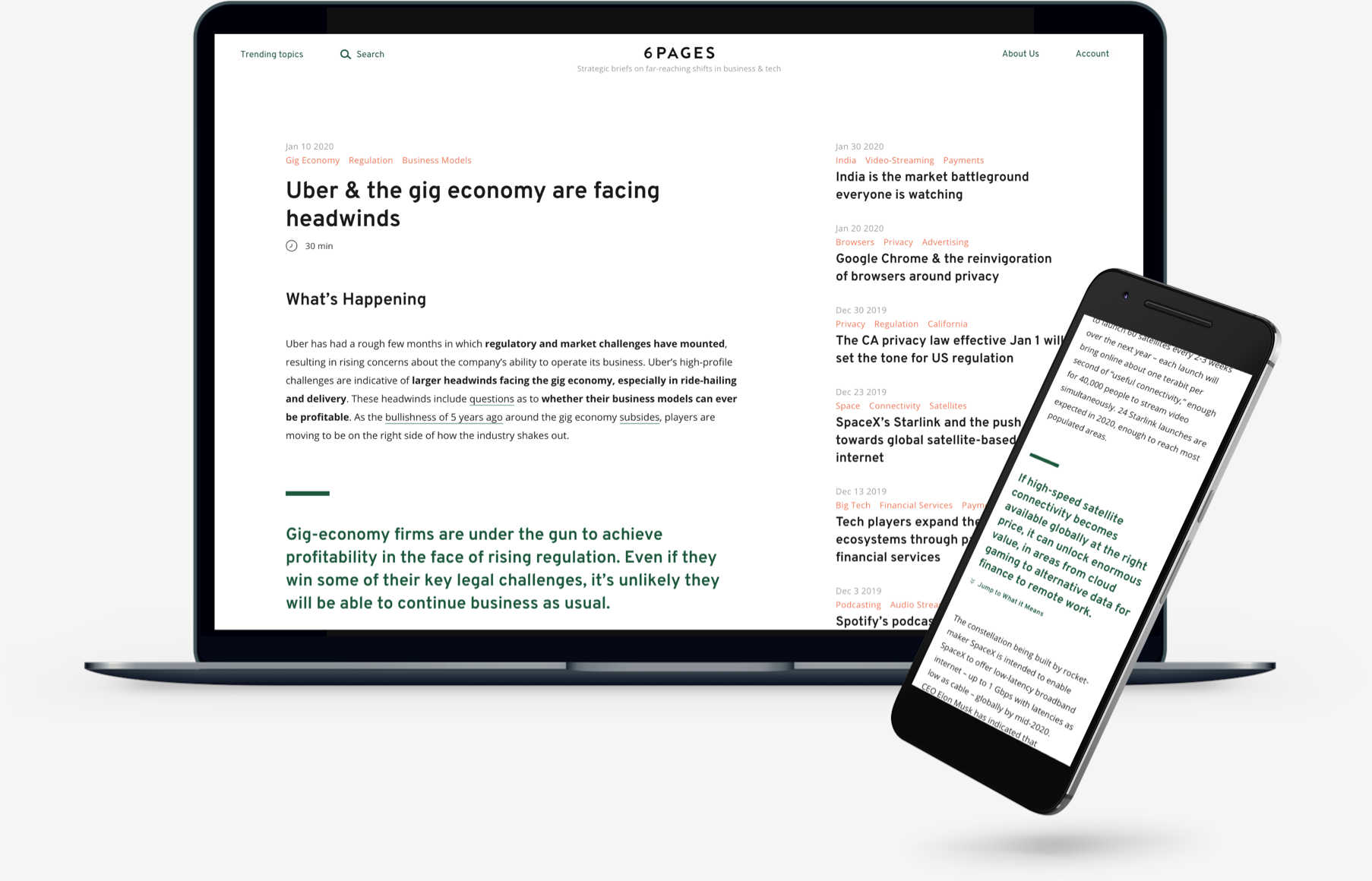
6Pages write-ups are some of the most comprehensive and insightful I’ve come across – they lay out a path to the future that businesses need to pay attention to.
— Head of Deloitte Pixel
At 500 Startups, we’ve found 6Pages briefs to be super helpful in staying smart on a wide range of key issues and shaping discussions with founders and partners.
— Thomas Jeng, Director of Innovation & Partnerships, 500 Startups
6Pages is a fantastic source for quickly gaining a deep understanding of a topic. I use their briefs for driving conversations with industry players.
— Associate Investment Director, Cambridge Associates
Read by
BCG
500 Startups
Used at top MBA programs including
Stanford Graduate School of Business
University of Chicago Booth School of Business
Wharton School of the University of Pennsylvania
Kellogg School of Management at Northwestern University
Reading Time Estimate
13 min read
Listen on:
Apple PodcastsSpotifyGoogle Podcasts
1. Trump signs executive order reclassifying marijuana
  • Yesterday, US president Donald Trump signed an executive order directing the Attorney General (AG) to complete the rulemaking to reschedule marijuana from a Schedule I drug – the most restrictive classification under the Controlled Substances Act (CSA) – to a Schedule III drug that could be made available through prescription. Recreational marijuana would remain illegal at the federal level, as would possession of state‑dispensary marijuana products that are not Food and Drug Administration (FDA)‑approved drugs. This is the continuation of a proposed rulemaking by the Justice Dept (DOJ) under then-president Joe Biden in May 2024. With Trump’s direction to complete the rulemaking “in the most expeditious manner in accordance with Federal law,” it could be pushed through in as little as 3-6 months. The EO comes at a time when Trump’s popularity could use a boost.
  • The EO directs Deputy Chief of Staff James Blair to work with Congress and federal agencies to update the definition and regulations for hemp-derived cannabinoid products. The language of the EO suggests that the updated regulations would allow for access to some products based on a THC-per-serving limit and CBD-to-THC ratio requirement, while placing restrictions on more potent products. The Federal Appropriations Bill recently closed a loophole that allowed for intoxicating hemp products (with other derivative compounds), which could be impacted by any update.
  • The Trump administration will initiate a pilot program that would authorize Medicare to cover medically recommended, regulated, hemp-derived CBD products at no cost for seniors, starting as early as Apr 2026. According to Medicare Administrator Mehmet Oz, Medicare patients can be eligible for coverage of up to $500 of CBD products each year. Last month, the Centers for Medicare & Medicaid Services (CMS) proposed a rule to authorize insurance coverage for CBD products under Medicare Advantage programs.
  • Historically, the AG has delegated the authority to reschedule drugs to the Drug Enforcement Administration (DEA), a part of the DOJ. CSA requires formal rulemaking for a drug rescheduling, including a notice to the public, a comment period, and an opportunity for an administrative hearing by the DEA. The notice by the DOJ back in May 2024 kicked off a 60-day public comment period that resulted in 43K public comments. The rulemaking has since been moving slowly through the DEA’s administrative process (during which time Trump took office), and is still awaiting an administrative law hearing.
  • Notably, the proposed rulemaking would not “legalize” marijuana, since it would still be considered a controlled substance. The DEA recognizes 5 categories of controlled substances from Schedule I to V, classified based on a drug’s acceptable medical use and potential for dependency/abuse.
  • A Schedule I drug like heroin, LSD, and ecstasy has “no currently accepted medical use and a high potential for abuse.” This description contradicts the current use of marijuana – a Schedule I drug since the CSA was first enacted in 1970 – for an array of conditions such as chronic pain, anxiety, insomnia, chemotherapy-induced nausea, pelvic pain, and Alzheimer’s-induced agitation. Examples of Schedule II drugs, also considered dangerous and highly controlled, include cocaine, methamphetamine, Vicodin, OxyContin, fentanyl, Adderall, and Ritalin. Schedule III drugs, which have “moderate to low” risk of dependence, include Tylenol with codeine, steroids, and testosterone. Schedule IV drugs (e.g. Xanax, Valium, Ambien) have a “low” risk of abuse/dependence. Schedule V drugs, which have an even lower risk, have very limited quantities of narcotics (e.g. Robitussin AC).
  • Notably, alcohol was “explicitly exempted from control under the CSA when it was enacted.” There are some lawmakers who have advocated for a full descheduling of marijuana so it can be treated like alcohol. For instance, descheduling could allow for excise taxes of up to 25% on marijuana.
  • The landscape has since changed. In Aug 2023, the HHS recommended that marijuana be rescheduled to Schedule III, based on a review and recommendation by the FDA based on more recent data, and concurrence by the National Institute on Drug Abuse. According to the DOJ’s Office of Legal Counsel (OLC), the DEA should accord the HHS’ medical and scientific determinations ‘‘significant deference’’ during the rulemaking process. The OLC also concluded that US treaty obligations could be met with supplemental controls after marijuana was reclassified. (In the meantime, the Single Convention treaty removed cannabis from its most restrictive schedule.)
  • A 2025 Gallup poll found that 64% of Americans support legalization of marijuana – up from 36% in 2005. The figure is higher for Democrats (85%) and independents (66%) but even among Republicans, a significant proportion (40%) support legalization. Given this public support, many – including the Congressional Research Service (CRS) and detractors like ex-DEA Administrator Asa Hutchinson believe the writing has been on the wall with respect to reclassification.
  • Perhaps most importantly, the Attorney General is vested with the final authority under the CSA “to schedule, reschedule, or decontrol drugs. The Attorney General has delegated that authority to the DEA Administrator, but also retains the authority to schedule drugs under the CSA in the first instance.” Given Trump’s emphasis during his second term on personal loyalty, it seems like the reclassification is virtually a done deal.
  • Reclassification would also make it easier to conduct clinical studies and other research on marijuana. Researchers studying Schedule I drugs need to register with the DEA and submit research protocols for review by the FDA, as well as meet stringent requirements for storage in electronic safes/vaults. Schedule III drugs are subject to fewer restrictions. With the reclassification, researchers could develop standardized dosing for medical marijuana, which is currently lacking.
  • Reclassification is expected to accelerate a market that’s already worth $31B+. The shift, which has been brewing since 2022, is luring in a diverse set of investors. These investors are hoping that reclassification is just an early stone in a cascade that will finally open up the marijuana industry in the US.
Related Content:
  • May 24 2024 (3 Shifts): The federal reclassification of marijuana
  • Jul 12 2024 (3 Shifts): The Chevron Doctrine and the end of an era
Become an All-Access Member to read the full brief here
All-Access Members get unlimited access to the full 6Pages Repository of850 market shifts.
Become a Member
Become a Member
Already a Member?
Disclosure: Contributors have financial interests in OpenAI, Anthropic, SpaceX, and Micron. OpenAI is a vendor of 6Pages.
Have a comment about this brief or a topic you'd like to see us cover? Send us a note at tips@6pages.com.
All Briefs
See more briefs

Get unlimited access to all our briefs.
Make better and faster decisions with context on far-reaching shifts.
Become a Member
Become a Member
Get unlimited access to all our briefs.
Make better and faster decisions with context on what’s changing now.
Become a Member
Become a Member