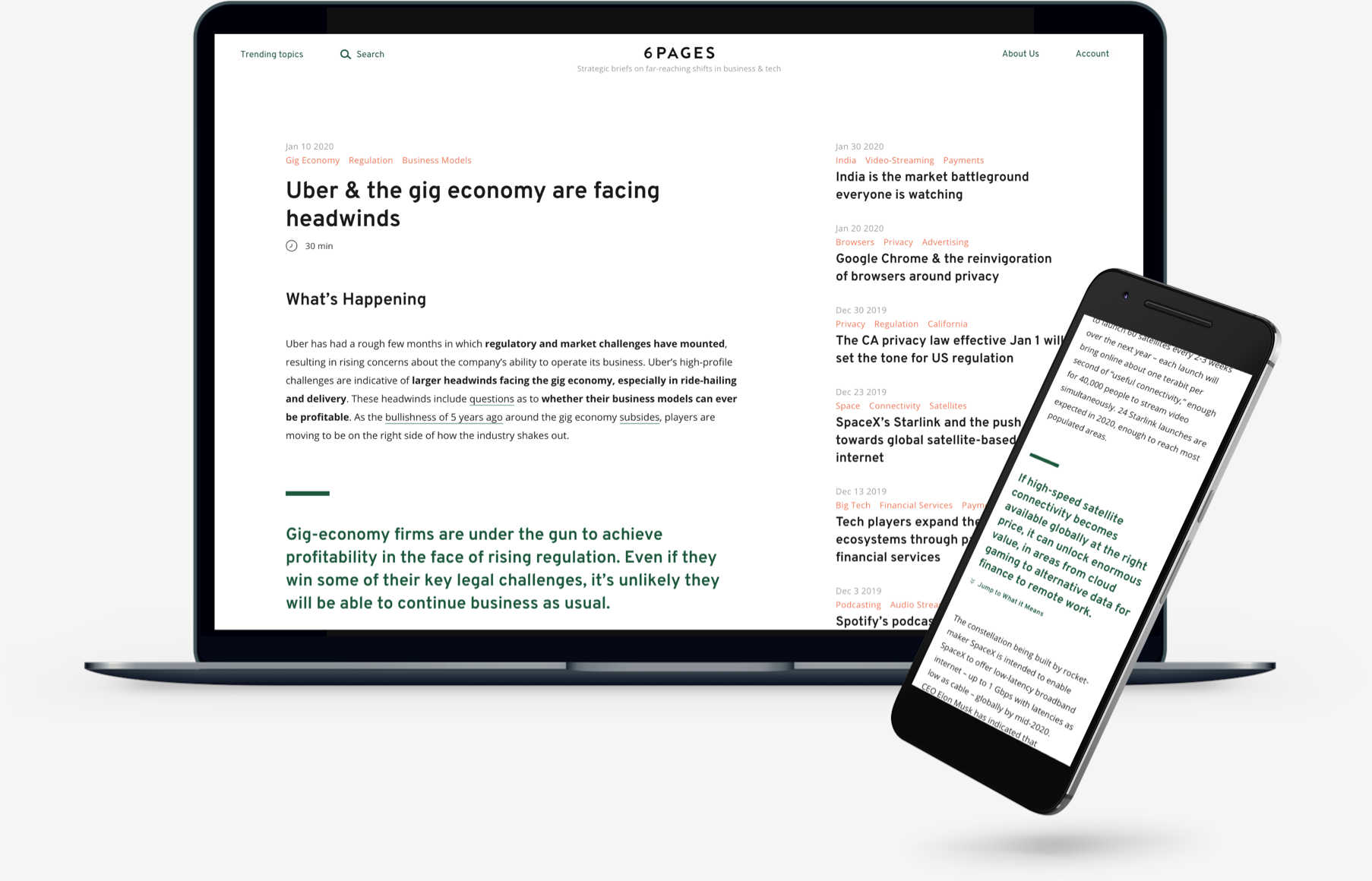
6Pages write-ups are some of the most comprehensive and insightful I’ve come across – they lay out a path to the future that businesses need to pay attention to.
— Head of Deloitte Pixel
At 500 Startups, we’ve found 6Pages briefs to be super helpful in staying smart on a wide range of key issues and shaping discussions with founders and partners.
— Thomas Jeng, Director of Innovation & Partnerships, 500 Startups
6Pages is a fantastic source for quickly gaining a deep understanding of a topic. I use their briefs for driving conversations with industry players.
— Associate Investment Director, Cambridge Associates
Read by
BCG
500 Startups
Used at top MBA programs including
Stanford Graduate School of Business
University of Chicago Booth School of Business
Wharton School of the University of Pennsylvania
Kellogg School of Management at Northwestern University
Reading Time Estimate
12 min read
Listen on:
Apple PodcastsSpotifyGoogle Podcasts
1. Consumers drawn to stablecoin yields
  • Consumers are seeing a tightening yield environment, with falling CD rates and less generous bank/credit card rewards. The national average rate on a 1-year CD was recently 1.55% (although competitive rates at some national banks can go up to 4.1%). Consumers in search of alternatives for parking their cash are being drawn to higher stablecoin yields – despite their heightened risk. Stablecoin yields can vary and fluctuate, ranging from 3% to 15% depending on risk, token, and incentive programs. Banks are warning that $6.6T in consumer deposits could be drained from banks if yield-bearing stablecoins continue to be allowed. The fight is reportedly holding up Congress’ passage of the broader Digital Asset Market Clarity Act that would govern crypto’s market structure and oversight.
  • The ability to earn yield on stablecoin has long been controversial. The GENIUS Act (Jul 2025) allowed for payment stablecoins pegged 1-to-1 to the US dollar and backed by reserves of traditional liquid assets – as opposed to yield-earning algorithmic stablecoins that try to peg to a fiat currency using financial engineering and active trading. (Up to 85% of today’s stablecoins are not currently meeting the GENIUS Act’s requirements.) Notably, the GENIUS Act explicitly barred any form of interest or yield paid directly by the issuer to the holder – a provision intended to limit disruption to existing banks.
  • Nevertheless, many stablecoin business models are centered on the interest or returns from the reserves backing the stablecoins. Custodial banks may hold the reserves but the earnings from them accrue to the issuer. Yield paid directly from issuers to holders is barred for stablecoins governed by the GENIUS Act. However, crypto firms are interpreting the law to mean that 3rd-party services – such as lending platforms, liquidity pools, and stablecoin reward systems – can pay yield to holders. (The OCC recently released proposed rules that could require issuers to restructure their 3rd-party agreements to delink yield and avoid the perception that they are trying to circumvent the GENIUS Act restriction.)
  • For example, Coinbase Business is offering a 3.5% annual yield on the USDC stablecoin (#2 by market cap) through a revenue-sharing agreement with USDC issuer Circle. Circle shares the return on the reserves backing USDC with Coinbase, which in turn shares the yield with users as "rewards" for holding USDC on its platform. Towards the other end of the risk continuum, Ethena sUSDe (USDE) – introduced Feb 2024 and now the #4 stablecoin – offers higher returns of 12.1% on average. Ethena, which is not governed by the GENIUS Act, is backed by riskier crypto collateral (instead of fiat reserves) and uses delta-hedging strategies to maintain its peg.
  • The big risk for a stablecoin is a market panic that leads to depegging. Perhaps the most notable depeg was TerraUSD (UST) – once the largest algorithmic stablecoin and #3 stablecoin overall – in May 2022. Its growth was driven by offers of up to 19.5% annual interest for TerraUSD deposits. Algorithmic stablecoins not backed by fiat reserves are particularly vulnerable to a “run on the bank” death spiral. TerraUSD’s decline was sparked by a series of large withdrawals, which destabilized the peg and rattled investors, who began panic selling. TerraUSD never recovered its peg.
  • In just 2025, there were major depegs by at least 7 decentralized stablecoins – First Digital USD (FDUSD) (Mar 2025), Synthetix sUSD (Apr 2025), Ethena USDe (Oct 2025), Staked Stream USD (XUSD) and Elixir deUSD (Nov 2025), StablesLabs USDX (Nov 2025), and Yala YU (Sep 2025 and Nov 2025). The depegs were caused by a combination of liquidity crunches (too many redemptions), shrinking collateral ratios (falling prices of crypto reserves), and technical risk (e.g. exploits, bad code, data-feed failures). About half of them recovered (including Ethena), while the stablecoins that depegged towards the end of 2025 generally did not.
  • Notably, the #1 and #2 stablecoins by market cap – Tether’s USDT and Circle’s USDC – are both centralized stablecoins, although only USDC is governed by the GENIUS Act. (Tether introduced US-compliant stablecoin USAT to avoid having to restructure its non-compliant USDT reserves.) Despite its stature, even USDC temporarily lost its peg in 2023 after the failure of Silicon Valley Bank, which held some of its reserves. USDT has also lost its peg a few times, including during the TerraUSD crisis and after crypto lender Celsius froze accounts in 2022. In Nov 2025, S&P downgraded USDT to “weak” due to the declining value of its bitcoin reserves.
  • Somewhat alarmingly, some consumers are treating stablecoins like cash. But stablecoins – even those governed by the GENIUS Act – are not FDIC-insured, which means holders run the risk of being wiped out. While there are ways to reduce some of the risks by conducting diligence on reserves, understanding exit paths and constraints, and selecting counterparties with care, higher returns generally accrue from higher risk. Coinbase Business, for instance, when it first launched, offered 4.1% yield on USDC, which is now down to 3.5%. Ethena launched with a 27.6% APY, which peaked a few weeks later at 67.2%, but is now down to 12.1% on average. Binance offers 12-35% but locks holders into its ecosystem. Consumers should assume that a higher return comes with higher risk, even if the risk is non-obvious.
  • Banks are reasonably concerned about the loss of deposits. Even without yield, stablecoins could drive $500B in deposit outflows over the next 3 years. On the high end, if anywhere close to $6.6T in consumer deposits leave traditional banks, it would put intense pressure on the banking sector – threatening banks’ liquidity and their ability to provide other services such as lending. It’s no wonder banks are pursuing their own stablecoin strategies – exploring tokenization of deposits, stablecoin payments, and stablecoin-linked cards.
  • There’s been a flurry of activity lately aimed at bringing stablecoin to the mass market. Meta is planning on implementing stablecoin payments in H2 2026. Stripe’s stablecoin infrastructure subsidiary Bridge recently joined the ranks of crypto firms with conditionally approved bank charters. (Kraken also just became the 1st crypto firm to get a Fed master account, albeit a “skinny” version.) Visa recently expanded its partnership with Bridge, offering stablecoin-linked Visa cards (2%-3.5% rewards in one case) in 18 countries and expanding to 100+ countries. (Other crypto cards are offering up to 4% back to lure customers, and overcome barriers like more complicated taxes.) Circle is partnering with Polymarket to bring USDC to its prediction market. While this shift is happening in fits and starts, we are moving towards a world where stablecoins – at least the largest ones – will be considered familiar and relatively safe by everyday consumers.
Related Content:
  • Jan 9 2026 (3 Shifts): The new class of stablecoin-based neobanks
  • Oct 31 2025 (3 Shifts): Stablecoin payments pick up steam
Become an All-Access Member to read the full brief here
All-Access Members get unlimited access to the full 6Pages Repository of877 market shifts.
Become a Member
Become a Member
Already a Member?
Disclosure: Contributors have financial interests in Meta and Alphabet. Google is a vendor of 6Pages.
Have a comment about this brief or a topic you'd like to see us cover? Send us a note at tips@6pages.com.
All Briefs
See more briefs

Get unlimited access to all our briefs.
Make better and faster decisions with context on far-reaching shifts.
Become a Member
Become a Member
Get unlimited access to all our briefs.
Make better and faster decisions with context on what’s changing now.
Become a Member
Become a Member