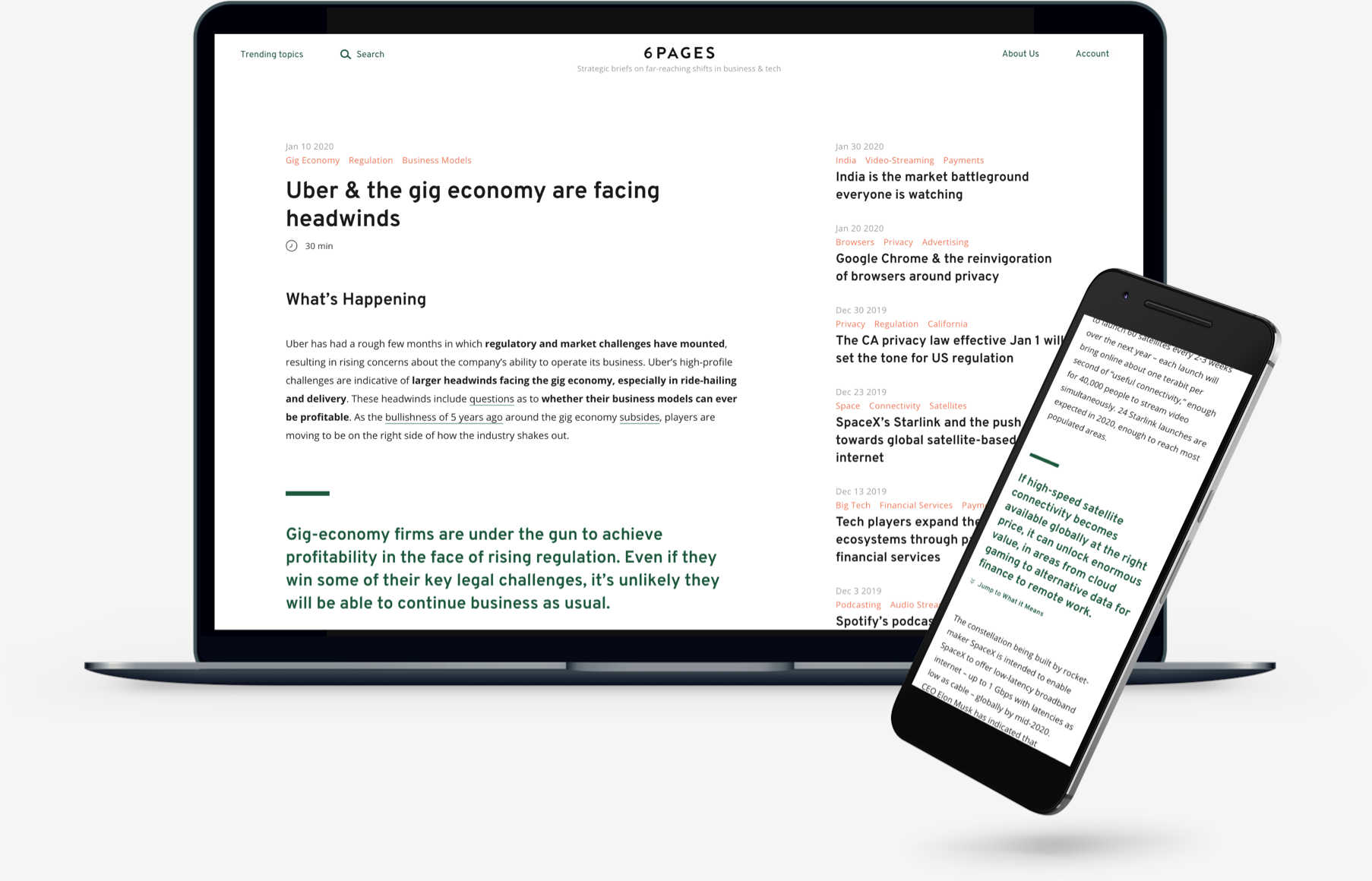
6Pages write-ups are some of the most comprehensive and insightful I’ve come across – they lay out a path to the future that businesses need to pay attention to.
— Head of Deloitte Pixel
At 500 Startups, we’ve found 6Pages briefs to be super helpful in staying smart on a wide range of key issues and shaping discussions with founders and partners.
— Thomas Jeng, Director of Innovation & Partnerships, 500 Startups
6Pages is a fantastic source for quickly gaining a deep understanding of a topic. I use their briefs for driving conversations with industry players.
— Associate Investment Director, Cambridge Associates
Read by
BCG
500 Startups
Used at top MBA programs including
Stanford Graduate School of Business
University of Chicago Booth School of Business
Wharton School of the University of Pennsylvania
Kellogg School of Management at Northwestern University
All Briefs
See more briefs

Reading Time Estimate
13 min read
Listen on:
Apple PodcastsSpotifyGoogle Podcasts
1. Banks will have a lot more free capital
  • We’re nearing the end of the 90-day comment period on US bank regulators’ Mar 19 2026 proposals that would reduce capital requirements by 4.8% for the largest banks (and varying for other banks based on size thresholds). The changes could go into effect as soon as 2 calendar quarters after final rules are adopted, unlocking an estimated $88B-104B in additional capital (beyond the $175B already held today in excess capital).
  • Background: This is just the latest in the bank capital requirements push-and-pull since the 2008 global financial crisis. The 2008 crisis exposed Basel II – the global framework that previously governed bank capital – as being too lax in allowing banks to be undercapitalized and over-leveraged. Coming out of the crisis, Basel III became the new global regime with strengthened supervision and higher capital minimums.
  • How Basel III changed bank capital ratios: The minimum high-quality capital ratios, as a % of risk-weighted assets (RWA), went from 4% in “Tier 1” capital to 6% in “Tier 1” capital and 4.5% in “Common Equity Tier 1” (CET1) capital (a higher standard that allows mostly just common stock and retained earnings). Basel III also required an additional 2.5% capital conservation buffer (CCB) to be met with CET1 capital (for a total of 7%). There was also an additional surcharge (1.0-3.5% in CET1 capital) for global systemically important banks (G-SIB), as well as a countercyclical buffer (0.0-2.5% in CET1 capital) in times when credit growth might be heightening systemic risk. In aggregate, a G-SIB bank would face an 8-13% CET1 capital requirement under Basel III – at least twice as much as before.
  • How the US applied Basel III: In the US, which phased the changes in over years, Basel III was layered on top of the post-crisis Dodd-Frank framework, resulting in even higher capital minimums. In lieu of the 2.5% CCB, the US imposed a bank-specific stress capital buffer (SCB) with a 2.5% floor on 31 large banks, which ranged from 2.5% to 11.5% in 2025. The US also provides an alternate method for calculating the G-SIB surcharge, which typically increases the Basel III surcharge by 0.5-1%. In the US, the G-SIB surcharge applies to 8 large banks and ranges from 1.0-4.5% based on bank size and complexity. The largest US bank, JPMorgan Chase, for example, has an aggregate CET1 capital requirement of 11.5%.
  • In Jul 2023, Biden-era bank regulators proposed changes that would have increased capital requirements by 16% on average, and as much as 19% in some cases. These proposed changes, called Basel III Endgame (aligning with 2017 revisions to Basel III), came in the wake of the Mar-May 2023 collapses of regional banks Silicon Valley Bank, Signature Bank, and First Republic. The Jul 2023 proposal caused a backlash that led regulators to indicate they would return to the drawing board. In Sep 2023, the Fed’s vice chair for supervision previewed changes that would cut the earlier 19% increase for the largest banks to about 9%, but saw a lukewarm reception.
  • The most recent proposals in Mar 2026 reflect a sharp reversal in loosening capital standards rather than tightening them. Among the drivers, regulators are seeking to bring mortgages and business lending back to the regulated banking sector. Tighter post-crisis regulation had shifted much of that activity to nonbank companies like Rocket Mortgage. Although it was a reversal, the recent proposals were passed 6-1 by the Fed Board of Governors, with just one dissent from the former Fed vice chair for supervision.
  • While changes can still be made, they are not expected to be sweeping in nature. The Fed has effectively told big banks not to push back, since the recent proposals are generally viewed as advantageous to banks. Still, the banks are pushing to get some more of their list of fixes in before the comment period closes on Jun 18 – and certainly before a Nov midterm election that could result in a less friendly regulatory environment. Banks are hoping to roll back a new requirement to hold capital against 10% of unused credit-card lines, reduce the G-SIB surcharge, treat trading book assets differently, and change how capital rules interact with the annual bank stress tests, as well as other items.
Related Content:
  • Oct 17 2025 (3 Shifts): The expanding retail-trading boom – a bubble or a shift?
Become an All-Access Member to read the full brief here
All-Access Members get unlimited access to the full 6Pages Repository of904 market shifts.
Become a Member
Become a Member
Already a Member?
Disclosure: Contributors have financial interests in Alphabet, Nvidia, and JPMorgan Chase. Google is a vendor of 6Pages.
Have a comment about this brief or a topic you'd like to see us cover? Send us a note at tips@6pages.com.
All Briefs
See more briefs

Get unlimited access to all our briefs.
Make better and faster decisions with context on far-reaching shifts.
Become a Member
Become a Member
Get unlimited access to all our briefs.
Make better and faster decisions with context on what’s changing now.
Become a Member
Become a Member